What happens to a bitcoin loan when the price falls
How the loan-to-value is measured, what the warnings at 75%, 80% and 85% mean, and who receives the bitcoin if a loan is liquidated, with a worked example.
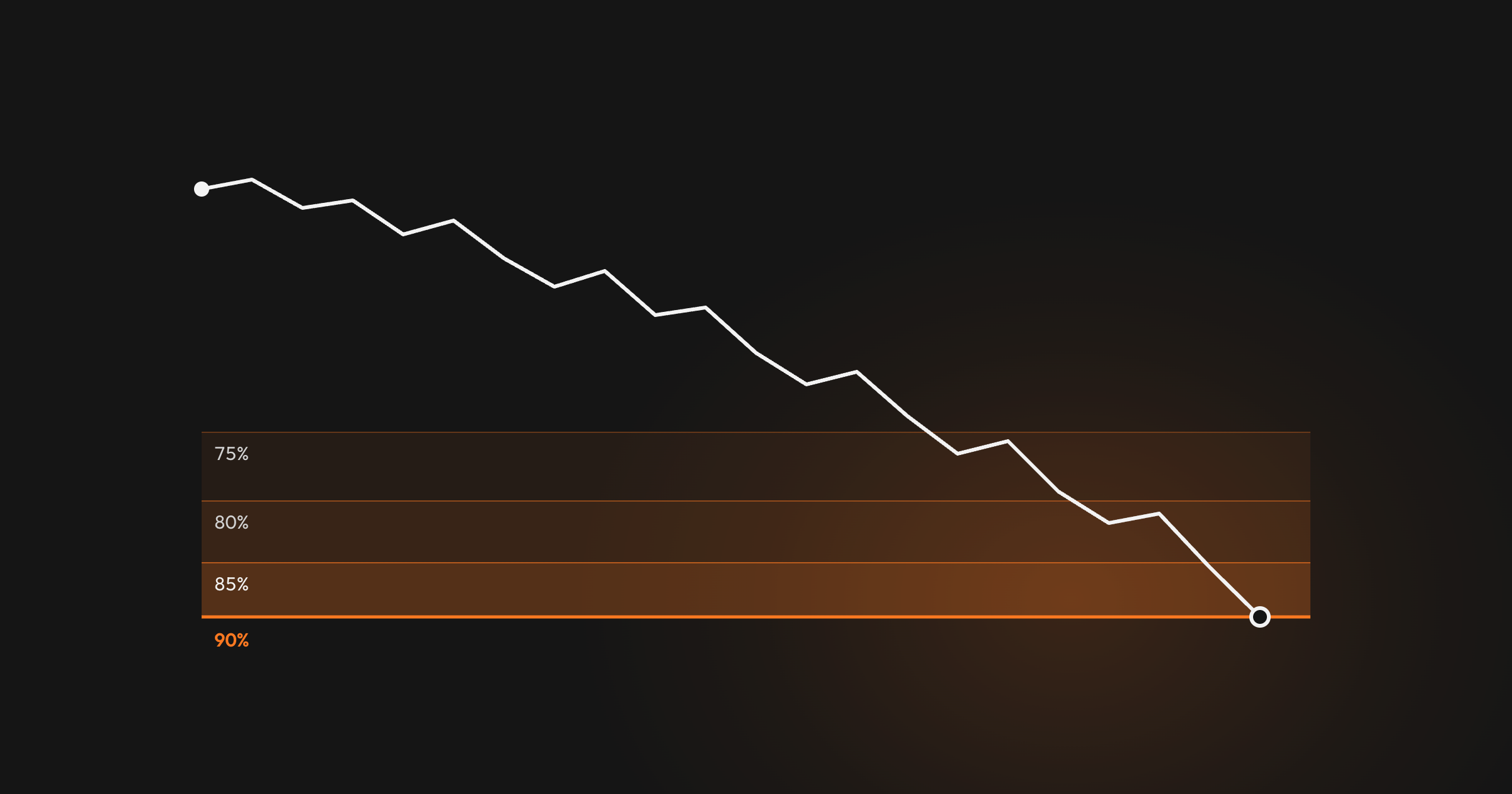
A bitcoin-backed loan is paid out and repaid in stablecoins, but it is secured by bitcoin, whose price changes from day to day. When the price falls, the same bitcoin covers less of the loan. If it falls far enough, the loan is liquidated and the bitcoin in the escrow is used to pay the lender.
This article follows one example loan on BTCBacked through a price fall. It covers how the loan-to-value is measured, the warnings at 75%, 80% and 85%, what the borrower can do, and what happens at 90% or when a loan reaches its end date unpaid. It also explains what the lender receives in a liquidation, and what happens if the collateral no longer covers the loan.
Throughout the loan, the collateral stays in a 2-of-3 multisig escrow on the Bitcoin blockchain. BTCBacked holds one of the three keys and cannot move the collateral alone. If a loan is liquidated, the lender is paid in bitcoin from the escrow, as explained below.
How the loan-to-value is measured
The loan-to-value (LTV) is the amount the borrower still owes, as a share of what the collateral is worth now.
LTV = amount still owed ÷ value of the bitcoin in the escrow
- The amount still owed is the loan amount plus the interest for the full term, minus the repayments the lender has confirmed.
- The value of the collateral is the bitcoin in the escrow at the current bitcoin price.
Interest on BTCBacked is charged for the whole agreed term from the start, and repaying early does not reduce it (Collateralized Loan Agreement, clause 25). The amount owed therefore does not grow over time. The loan-to-value moves with the bitcoin price, with top-ups (bitcoin the borrower adds to the escrow) and with repayments.
Each offer sets a loan-to-value between 30% and 70%, which decides how much collateral the borrower deposits: the lower the percentage, the more bitcoin. BTCBacked checks the loan-to-value of each running loan every minute, using the median bitcoin price from the price sources listed on the platform (Escrow Terms, Section 12). This gives a buffer against brief price swings: a drop that lasts only a few seconds is usually over before the next check, and a spike or drop on a single exchange does not by itself move the median price.
The same formula gives the bitcoin price at which a loan reaches 90%, the level at which it is liquidated:
Liquidation price = amount still owed ÷ (0.9 × bitcoin in the escrow)
The example loan
The example below is illustrative, and so is its interest rate.
- A loan of 10,000 USDT for 12 months.
- Interest at 8% a year, which is 800 USDT for the full term. The borrower owes 10,800 USDT in total.
- A starting loan-to-value of 50%.
- A bitcoin price of 100,000 USD when the loan is agreed.
At a 50% loan-to-value, the collateral must be worth twice the 10,800 USDT owed, which is 21,600 USD, or 0.216 BTC at 100,000 USD. The borrower deposits this into the escrow together with the platform fee and a small amount to cover the network fee. The platform fee is 1.5% per year of the loan term, charged once: for this 12-month loan, 150 USD, which is 0.0015 BTC at that price. It is paid after the borrower confirms receiving the loan.
Cost of the example loan
| Item | Illustrative example |
|---|---|
| Marketplace operator | BTCBACKED AG, Zug |
| Loan amount | 10,000 USDT |
| Term | 12 months |
| Interest rate | 8% a year (illustrative), which is 800 USDT for the full term. Rates are set in each offer by the borrower or lender who posts it, not by BTCBacked. |
| Platform fee | 1.5% per year of the loan term, charged once. For this loan, 150 USD, paid in bitcoin (0.0015 BTC at 100,000 USD) |
| Total cost (interest and platform fee) | 950 USD |
| Total amount payable | 10,950 USD (10,800 USDT to the lender and the 150 USD platform fee) |
| Annual percentage rate (APR), including the platform fee | 9.64% |
| Not included | Bitcoin network fees, which vary. The liquidation fee of 5% of the loan amount, paid in bitcoin from the collateral, due only if the loan is liquidated. |
What happens as the price falls
In the example, the 10,800 USDT owed stays the same while the 0.216 BTC in the escrow loses value. With no top-ups or repayments, the loan passes these points:
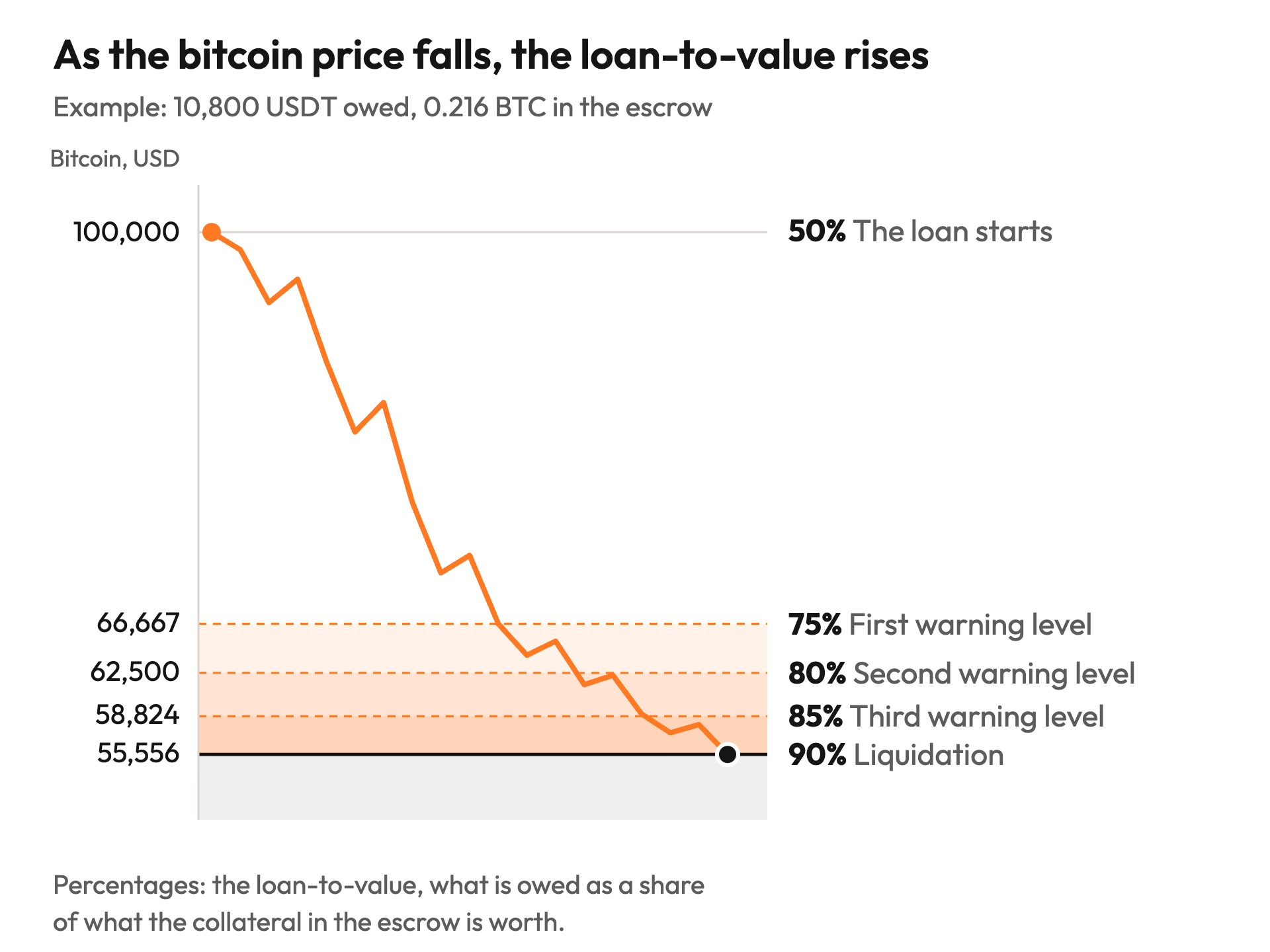
- Bitcoin at 100,000 USD. The loan starts at a loan-to-value of 50%.
- 66,667 USD, a fall of 33%. The loan reaches 75%, the first warning level.
- 62,500 USD, a fall of 37.5%. 80%, the second warning level. From here the lender can sign a liquidation in advance.
- 58,824 USD, a fall of 41%. 85%, the third warning level.
- 55,556 USD, a fall of 44%. 90%. The loan is liquidated.
A loan has three warning levels: 75%, 80% and 85%. When the loan reaches one of them, BTCBacked warns both the borrower and the lender, by email and in the app. The loan-to-value is checked every minute, so in a fast fall a level can be skipped, and at 90% the loan goes to liquidation without a further warning. The Escrow Terms call these warnings margin calls. Each warning email shows the current loan-to-value and the bitcoin price at which the loan would be liquidated.
The warnings do not stop a liquidation (Escrow Terms, clause 22). In the example, the price falls a further 17% between the first warning level and liquidation, and under 6% between the third warning level and liquidation. A fast market can cover that distance before the borrower has time to respond (Collateralized Loan Agreement, clause 34).
How the borrower can lower the loan-to-value
Before the loan reaches 90%, the borrower can bring the loan-to-value down in two ways.
Add collateral. While the loan runs, the borrower can send more bitcoin to the same escrow address. The app suggests an amount that brings the loan-to-value back to 70%. Before sending, the borrower enters the amount and where the bitcoin comes from (Escrow Terms, clause 18). A top-up counts toward the loan-to-value as soon as it appears on the Bitcoin network, unless its network fee is too low for it to confirm in time (Escrow Terms, clause 28).
Repay part of the loan. The borrower can repay early, in one or several payments, directly to the lender. A repayment counts toward the LTV once the lender confirms it, and the lender has 12 hours to confirm or dispute each one (Collateralized Loan Agreement, clause 27). The interest stays the same, and each confirmed repayment lowers the amount still owed.
In the example, at 80% (bitcoin at 62,500 USD), either step brings the LTV back to 70%:
- adding about 0.031 BTC, worth about 1,929 USD at that price, or
- repaying 1,350 USDT, which leaves 9,450 USDT owed.
Once the loan reaches 90% and a liquidation is triggered, it goes ahead even if a top-up or repayment is confirmed afterwards (Escrow Terms, clause 29). If the borrower has made a repayment that the lender has not yet confirmed when the loan reaches 90%, the loan goes to a dispute instead of being liquidated straight away.
Liquidation at 90% loan-to-value
When the loan-to-value reaches 90%, the loan is liquidated. BTCBacked prepares the liquidation transaction, the lender signs it, and BTCBacked adds the second signature. From 80%, the lender can choose to sign a price liquidation in advance, so it can be completed at 90% even if the lender is offline. A top-up or a repayment cancels a pre-signed liquidation, and the lender can then sign a new one (Escrow Terms, clauses 23 to 26).
The Escrow Terms set the order in which the collateral is paid out (clause 30):
- The lender receives bitcoin worth up to the amount still owed, principal plus interest.
- BTCBacked receives its liquidation fee: 5% of the loan amount, converted into bitcoin at the same price used to pay the lender. The fee comes from what is left after the lender, so it is reduced, or not paid, if the collateral does not cover it.
- The borrower receives the rest at their refund address. If the borrower has not linked a refund address yet, the rest stays in the escrow until they do (clause 31).
Which bitcoin price is used. Normally it is the market price when BTCBacked prepares the liquidation for the lender to sign. If the lender signed in advance, the amounts were fixed when they signed, at the price at which the loan reaches 90%.
In the example, at 55,556 USD the 0.216 BTC in the escrow is worth 12,000 USD. It is paid out like this:
| Paid to | Bitcoin | Value at 55,556 USD |
|---|---|---|
| Total in the escrow | 0.216 BTC | 12,000 USD |
| Lender (10,800 USDT owed) | 0.1944 BTC | 10,800 USD |
| BTCBacked (liquidation fee) | 0.009 BTC | 500 USD |
| Borrower's refund address | 0.0126 BTC, less the network fee | About 700 USD, before the network fee |
The lender is paid in bitcoin. The bitcoin goes from the escrow straight to the lender's own bitcoin address, and nothing is sold on the way. A lender who wants stablecoins back converts the bitcoin themselves, and the price can move in the meantime.
Liquidation at the end date
If the full amount has not been repaid by the end date, the loan is liquidated on that date (Collateralized Loan Agreement, clause 38). There is no grace period, and loans cannot be extended. The borrower receives reminders 7 days and 1 day before the end date. If a repayment is still waiting for the lender's confirmation at the end date, the loan goes to a dispute first (clause 39).
The payout follows the same order. In the example, if the loan reaches its end date unpaid with bitcoin still at 100,000 USD, the lender receives 0.108 BTC (10,800 USD), BTCBacked receives 0.005 BTC (500 USD), and the borrower receives 0.103 BTC (10,300 USD), less the network fee.
If the price falls faster than the liquidation
A sharp fall can take the price well past the 90% level before a liquidation is completed. The collateral can then be worth less than what is owed. In the example, at 48,000 USD per bitcoin, the whole 0.216 BTC is worth 10,368 USD, less than the 10,800 USDT owed.
The borrower's liability is limited to the collateral. After a liquidation, the borrower owes nothing more under the loan agreement, even if the lender received less than the full amount (Collateralized Loan Agreement, clause 41). The lender bears that shortfall. For lenders, the escrow secures the collateral, not its value.
What to check before you agree a loan
- Work out the liquidation price from the starting loan-to-value, and how far the price can fall before the first warning and before liquidation.
- As a borrower, know where you would find extra bitcoin or stablecoins at short notice, and link a refund address early.
- As a lender, decide whether you will pre-sign a liquidation from 80%, and note that a liquidation pays you in bitcoin.
To see the terms borrowers and lenders are offering, sign up to browse loan offers. For how each side works, see Borrowing and Lending.
About BTCBacked. BTCBacked is a Swiss marketplace for non-custodial bitcoin-backed loans, headquartered in Zug. Borrowers and lenders agree the terms directly, and the collateral sits in a 2-of-3 multisig escrow on the Bitcoin blockchain. BTCBacked is supervised as a Swiss financial intermediary by VQF (member #101306). More about us
Last reviewed: 13 October 2026. This article explains how loan-to-value and liquidation work on BTCBacked. The figures are an illustrative example. It is not legal, tax or investment advice.
Borrow against your Bitcoin without handing it to a custodian
Join BTCBacked and keep your key while you access liquidity.