How a 2-of-3 multisig bitcoin loan works: who holds the keys and who signs what
Three keys, two signatures. Who holds each key, who signs at each stage of the loan, and what happens if BTCBacked goes offline.
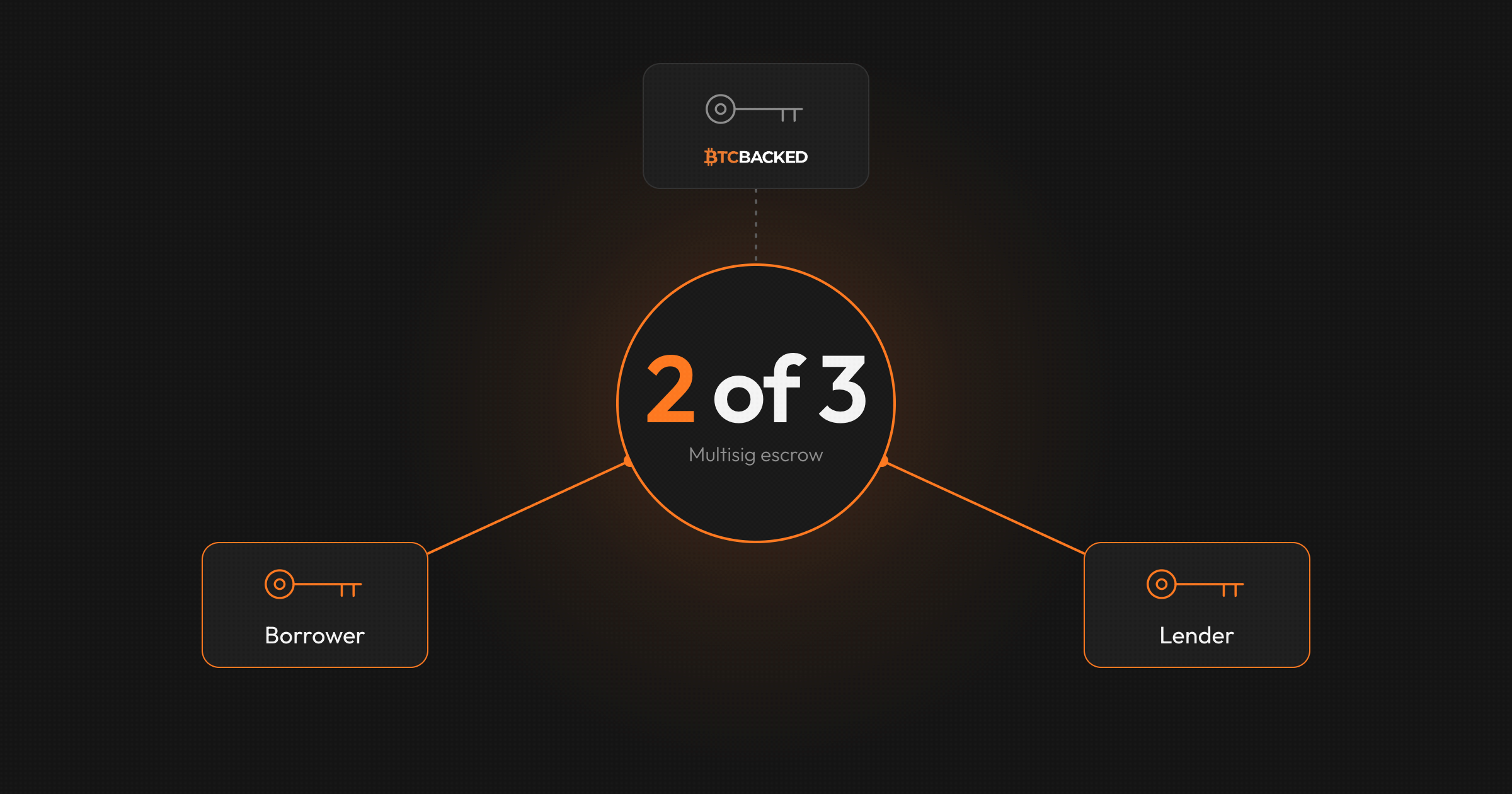
In a 2-of-3 multisig bitcoin loan, the collateral sits at a Bitcoin address that needs two of three keys to move it. The borrower, the lender and the platform each hold one key. Platforms for bitcoin-backed loans rightly point out that no single party can move the collateral. That still leaves the useful questions open. Which two parties can move it together? When does each of them sign? What happens if one of them disappears?
This article answers those questions for the escrow used on BTCBacked, step by step. The same questions are worth asking of any platform that uses multisig collateral.
What 2-of-3 means
A multisig address is a Bitcoin address that needs more than one key to spend from. In a 2-of-3 setup, three keys are tied to the address and any two of them must sign before the bitcoin can move. One signature on its own does nothing.
The rule is written into the address, and the Bitcoin network enforces it. The network rejects any transaction from the address that carries only one valid signature.
Who holds the three keys
Every loan on BTCBacked has three keyholders: the borrower, the lender and BTCBacked, each with one key.
Borrower and lender each choose where their key comes from:
- Created from a password. The key is generated in your browser from a password you choose. The password and the private key never leave your device. BTCBacked receives the public key and a random value used to create your key. Neither can sign anything. Because the key comes from your password, choose a long, unique one. Nobody, including BTCBacked, can reset a forgotten password.
- Your own wallet. The key comes from a wallet you control, such as a Ledger, Trezor or Jade hardware wallet. It signs only when you approve a transaction.
BTCBacked's own key is held in a signing service that runs separately from the rest of the platform. BTCBacked never holds the borrower's or the lender's key.
One escrow address per loan
When a loan is agreed, a new escrow address is created from the three public keys. Each loan has its own address, so one customer's collateral is never pooled with another's.
The borrower sends the bitcoin collateral to that address, together with the platform fee and a small amount to cover the network fee for paying it. From then on, anyone can look the address up on a block explorer, a public website that shows Bitcoin transactions, and see the bitcoin there. The collateral is not moved into a company account.
The address has no timelock, a rule that would release the bitcoin to someone automatically after a set date. It moves only when two of the three keys sign.
The loan amount does not pass through BTCBacked. The lender sends the stablecoins (USDT or USDC) directly to the borrower, and the borrower repays directly to the lender.
Who signs what
Every movement of the collateral needs two signatures. Which two depends on what is happening.
| What happens | Who signs |
|---|---|
| A loan is cancelled before it starts and the deposit is refunded | Borrower and BTCBacked |
| The platform fee is paid from the escrow | Borrower and BTCBacked |
| The borrower has repaid in full and the collateral is released | Borrower and BTCBacked |
| The loan is liquidated (loan-to-value reaches 90%, or the loan is unpaid at maturity) | Lender and BTCBacked |
| A dispute opens | BTCBacked checks the blockchain record, then signs with the side it supports, or the loan continues |
| BTCBacked is not available | Borrower and lender together |
Three of these need more detail.
Repayment. Once the lender has confirmed the full repayment, the borrower signs the release and BTCBacked adds the second signature. The bitcoin goes to the borrower's verified refund address, less the network fee.
Liquidation. The loan-to-value is the amount owed as a share of the collateral's current value. If it reaches 90%, or the loan is unpaid at maturity, the lender signs and BTCBacked adds the second signature. From 80%, the lender can choose to sign a price liquidation in advance, so it can be completed at 90% even if the lender is offline. The collateral is then paid out in a fixed order: first what the borrower owes the lender, then BTCBacked's liquidation fee, then anything left to the borrower's refund address. If the borrower has not linked a refund address yet, the rest stays in the escrow until they do (Escrow Terms, clause 31).
Disputes. A dispute opens if either side raises one, or if within 12 hours the lender does not report sending the loan, the borrower does not confirm receiving it, or the lender does not confirm a repayment. A missed deposit deadline cancels the loan instead, and a loan unpaid at maturity is liquidated. Disputes are decided on the record. BTCBacked asks the other side for its comments and looks at the loan documents and the objective technical records: blockchain transaction data, timestamps and confirmations (Escrow Terms, clauses 36 and 37). Most disputes come down to whether a payment was made. Loan payments and repayments are stablecoin transfers on a public blockchain, each with a transaction ID anyone can check, so the answer is usually clear: the transfer is on the blockchain or it is not. BTCBacked then signs with the side the record supports: with the borrower to release the collateral, or with the lender to liquidate it. If nothing is wrong, the loan simply continues, and if evidence is missing, BTCBacked waits for it before signing (clause 38). It aims to resolve a dispute within five business days (clause 39).
Why three keys and not two
A setup with only two keys, the borrower's and the lender's, looks simpler. But it lets either side freeze the collateral by walking away. A borrower who stops responding could block a liquidation, and a lender who stops responding could block a release.
The third key exists to settle those cases. BTCBacked can sign with the borrower to release, or with the lender to liquidate. It can never sign alone.
What the escrow protects you from
- Any single party acting alone. None of the three keyholders can move the collateral with one key.
- Your collateral being pooled or lent on. The bitcoin stays at its own address for the whole loan. Neither BTCBacked nor the lender can take it and lend it to someone else on their own.
- BTCBacked stopping operations. Borrower and lender hold two of the three keys between them. Provided each has kept the loan's recovery file, that is enough to move the collateral without BTCBacked.
What it does not protect you from
- A falling bitcoin price. If the loan-to-value reaches 90%, the collateral is liquidated. Warnings at 75%, 80% and 85% give the borrower a chance to add collateral or repay part of the loan. A fast fall can leave little or no time to act, and the warnings do not stop a liquidation once 90% is reached.
- A lost password or key. A forgotten password cannot be reset. If you use your own wallet, keeping its backup safe is your responsibility.
- Needing a second signer. Neither borrower nor lender can take the collateral out of the escrow alone.
For lenders, the escrow secures the collateral, not its value. If the price falls faster than a liquidation can complete, the collateral may be worth less than what is owed, and the lender bears that shortfall (Collateralized Loan Agreement, clause 41).
If BTCBacked stops operating
Borrower and lender can move the collateral without BTCBacked. Each of them should download the loan's recovery file from the dashboard while the loan is running, and keep it safe.
The BTCBacked recovery tool runs in your browser, and its source code is public. You can also download it and use it offline. Rebuilding your key and signing both work without an internet connection. You only need to go online to check the escrow balance and to send the signed transaction to the Bitcoin network. If your key was created from a password, the tool rebuilds it from the recovery file and your password. If you use your own wallet, the tool gives you a file to load into your wallet app, such as Sparrow, and you sign on your device. One side signs a transaction and passes it to the other, who adds the second signature and sends it to the Bitcoin network.
This still needs both of you. Borrower and lender have to agree where the bitcoin goes, and both have to sign.
If someone loses a key
Because any two keys are enough, the other two parties can still settle a loan if one party loses its key. The Escrow Terms require them to cooperate in good faith (clause 42). There is no automatic way to do this, and a borrower who loses the password cannot sign the normal release (Terms of Use, clause 2).
Questions to ask about any multisig loan
Whether you borrow or lend, and on any platform, these questions show how a platform protects the collateral:
- Who holds each key, and does the platform ever hold your key or your password?
- Which pairs of keys sign for what: repayment, liquidation, disputes?
- Who decides a dispute, and on what evidence?
- Is there a timelock that releases the collateral to someone automatically?
- Can you and your counterparty recover the collateral without the platform, and with what tool?
- Is each loan's collateral at its own address, visible on the blockchain?
On BTCBacked, the answers are in this article and in the published Escrow Terms.
To see the terms lenders and borrowers are offering, sign up to browse loan offers. For how the lender side works, see Lending.
About BTCBacked. BTCBacked is a Swiss marketplace for non-custodial bitcoin-backed loans, headquartered in Zug. Borrowers and lenders agree the terms directly, and the collateral sits in a 2-of-3 multisig escrow on the Bitcoin blockchain. BTCBacked is supervised as a Swiss financial intermediary by VQF (member #101306). More about us
Last reviewed: 25 September 2026. This article explains how the escrow works. It is not legal, tax or investment advice.
Borrow against your Bitcoin without giving up custody
Join BTCBacked and keep your keys while you access liquidity.